“Our company was established in 1987 as a family-run business. At the beginning, we operated in a small facility of around 200 square metres together with my parents and my brothers. From the very beginning, we focused strongly on service, quality, and continuous growth. In 1994, we moved to a larger facility, but even then, I knew that sooner or later, we would need to make another dimensional leap. Over the years, we continuously invested in plants and equipment, culminating in our 2020 relocation to the current site. Here, we were able to make significant investments: a new purification plant, additional ironing lines, new continuous washing machines, and a much more efficient production organization. The goal was not just to increase production capacity but to make the entire flow more orderly and measurable: soiled item intake, selection, washing, finishing, folding, packaging, delivery preparation, and clean item return. In a seasonal market like Puglia's, efficiency is measured not only during summer peaks but in the ability to maintain continuity and quality throughout the year.”
“Absolutely. I've always had a vision strongly oriented towards the industrial evolution of the company. Over time, it hasn't always been easy to change pace: moving from a more artisanal logic to an industrial vision requires decisions, investments, and a new organizational culture. But for me, it was clear that the laundry needed to grow, structure itself, and continuously improve.”
“We started with the restaurant sector, like many laundries. living in Puglia, naturally also the banqueting and catering segments. Today, these three segments have been the core of our business for over 25 years. Since 2020, we have also started working with workwear and PPE, although our main focus remains on the hotel and banqueting sectors, two sectors that are growing significantly in Puglia.”


Do you also operate in the healthcare sector?
“Not yet. It's a sector that interests me, but I believe it requires a dedicated production unit. I prefer to enter that market only when I can guarantee the highest level of organizational standards.”
“Our approach is very oriented towards long-term relationships. Most clients have multi-year contracts, generally three years. We are also working extensively on linen customization, introducing formulas based on washing cycles, for example, with guarantees of up to 70 washes for personalized products.”

“The spot portion is minimal. It exists mainly in catering or for occasional events, but we're talking about a very small share. Over 99% of our work comes from continuous and structured relationships.”
Let's focus on business distribution.
How is your revenue divided today?
“Roughly, I would say:
• 50% hotel sector
• 30% catering
• 20% banqueting and reception halls”.
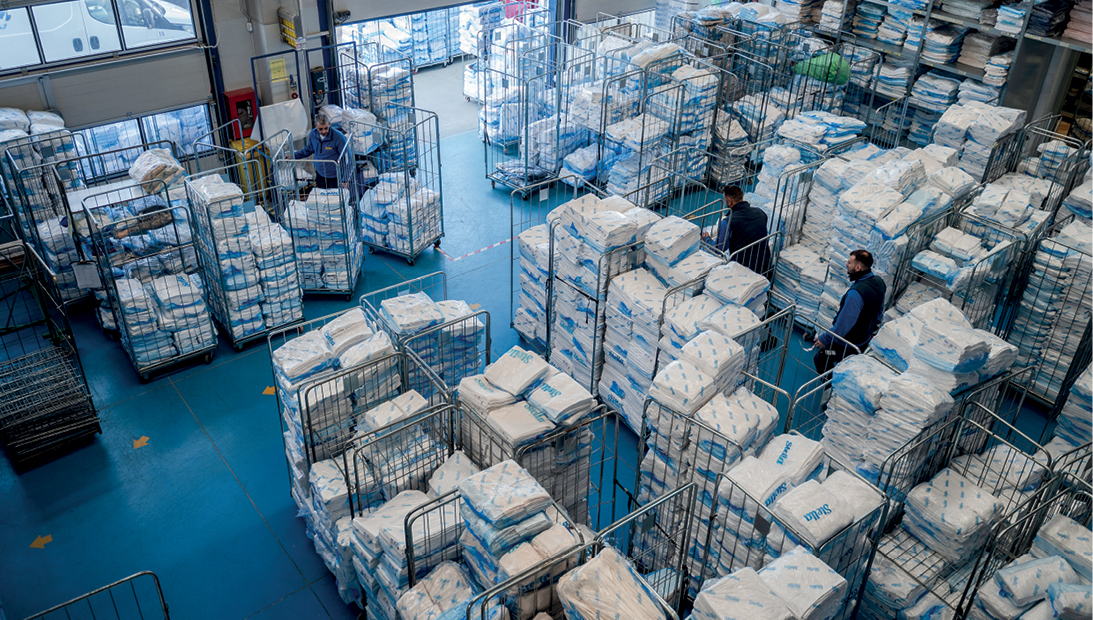
“After moving to the new facility and overcoming the COVID period, we've seen very strong growth since 2023. We can say we've nearly tripled our revenue compared to the previous phase. But it's not just about quantity. I've also invested heavily in material quality, equipment, and production efficiency.”
 What does quality mean today for an industrial laundry?
“Quality is not a single result; it is a system. It means managing flows correctly, choosing the right products, training people, controlling processes, and maintaining the same standards even during peak production periods. An industrial laundry cannot be excellent only when it's working at low capacity; it must demonstrate reliability especially when production pressure increases.”
What role do traceability and technology play in your production model?
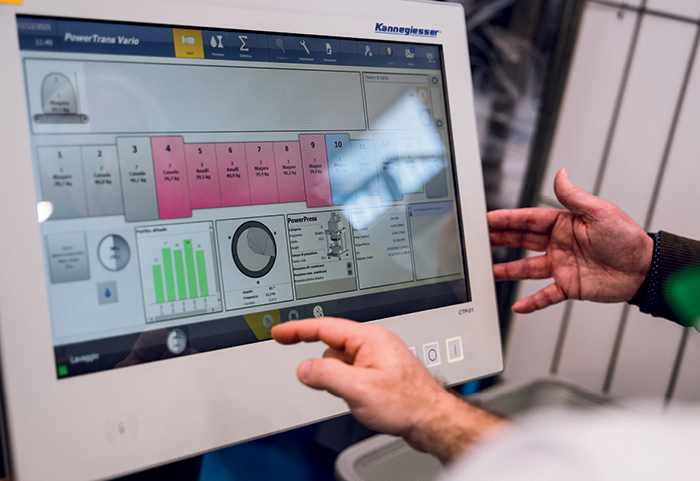
“We are also working on traceability and more advanced garment management. Technologies like RFID and identification systems allow us to reduce errors, improve garment management, monitor product lifecycles, and offer a more reliable service to clients. This is an inevitable direction for laundries that want to grow in an organized manner.”
“Labor is certainly a very important component. We currently employ about 45 employees during the high season, of which about 35 are permanent and 10 are seasonal.
We have invested heavily to reduce energy costs:
• We installed photovoltaic panels, which today cover about 50% of our consumption;
• We installed a new high-efficiency boiler;
• Heat recovery; improved insulation, and optimization of steam and condensate return make a difference. ”
The energy issue has become central to industrial management. This is why Lavanderia Stella has invested on multiple fronts: photovoltaics, a new high-efficiency boiler, heat recovery, insulation, steam optimization, and condensate return. These are not isolated interventions but a progressive strategy to make production more efficient, sustainable, and less exposed to energy cost volatility.
“To continue growing without losing quality. For me, the modern industrial laundry must be reliable, organized, and capable of continuous evolution. Investments are fundamental, but they are not enough on their own. Vision, method, and consistency are needed. The industrial laundry of the future will be increasingly organized, technological, and sustainable, but it must remain deeply tied to service quality. It is on this balance that we want to continue growing.” •

DETERGO MAGAZINE # JULY AUGUST 2026