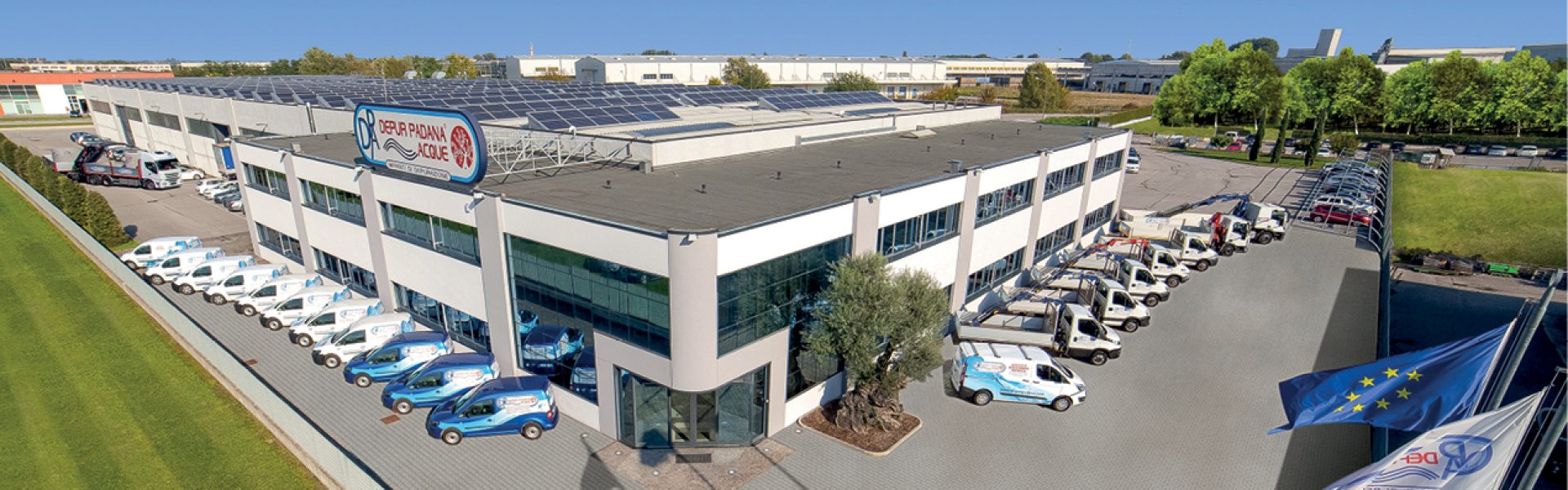
We are talking about DEPUR PADANA ACQUE, a company with over one hundred employees where professionalism, experience, passion, and expertise masterfully blend thanks to the precise coordination of CEO Rodrigo Padoan and the founder Rossano Padoan. The “family-run business” does not end here, as during my company tour, I also met environmental engineer Marianna Padoan in the planning and design office. We focus our attention moreover on the laundries sector, divided in “laundry laboratories” and “industrial laundries”, different for their size, but different also for the type of service they offer.
Rossano Padoan, the founder of DEPUR PADANA ACQUE, has come a long way since he took his first steps in Milan in the early ’70s searching for work and entrepreneurial success. “I started,” he tells us, “by doing technical work, sales, marketing, and I always had to keep a watchful eye on the company’s accounts and finances.” Then, at the end of the ’70s, he returned home to Rovigo, where the company has its headquarters today.
A province crossed by the impressive waterways of the Adige and Po rivers, creating a natural habitat so distinctive that the entire delta area is famously referred to as the Italian Camargue. The company is located in the southern industrial area of the city. The central, crucial, and defining element of the territory is water. There is undoubtedly a symbiosis between the territory and the mission, the “raison d’être” (the reason of existence), and the essential nature of DEPUR PADANA ACQUE.
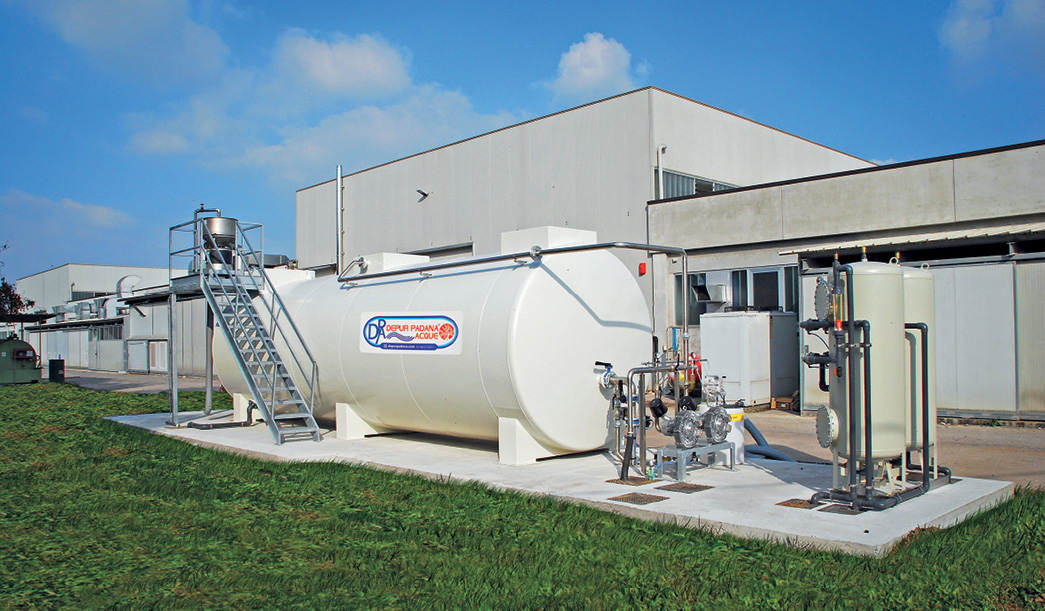
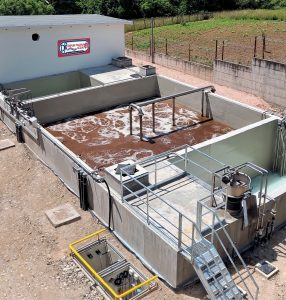
Biological wastewater purification plant ECOBLOCK® series equipped with
S.B.R. technology (Sequencing Batch Reactor) for treating effluent waters
resulted from industrial washing machines. Capacity 25 m3/day.
Installation at TRERЀ INNOVATION company – ASOLA (MN)
How was the wastewater purification carried out until a few years ago?
“The classical biological purification with activated sludge was always used, but today the added value is that MBR (Membrane BioReactor) plants are much more efficient, and, not least, they require less space. This is because the oxidation section, which has always had a significant volume, can be halved or even further reduced thanks to MBR technology. Another specific feature of this technology, which can also be integrated on existing plants, is exactly the significant reduction in the space requirements of the purification plant”.
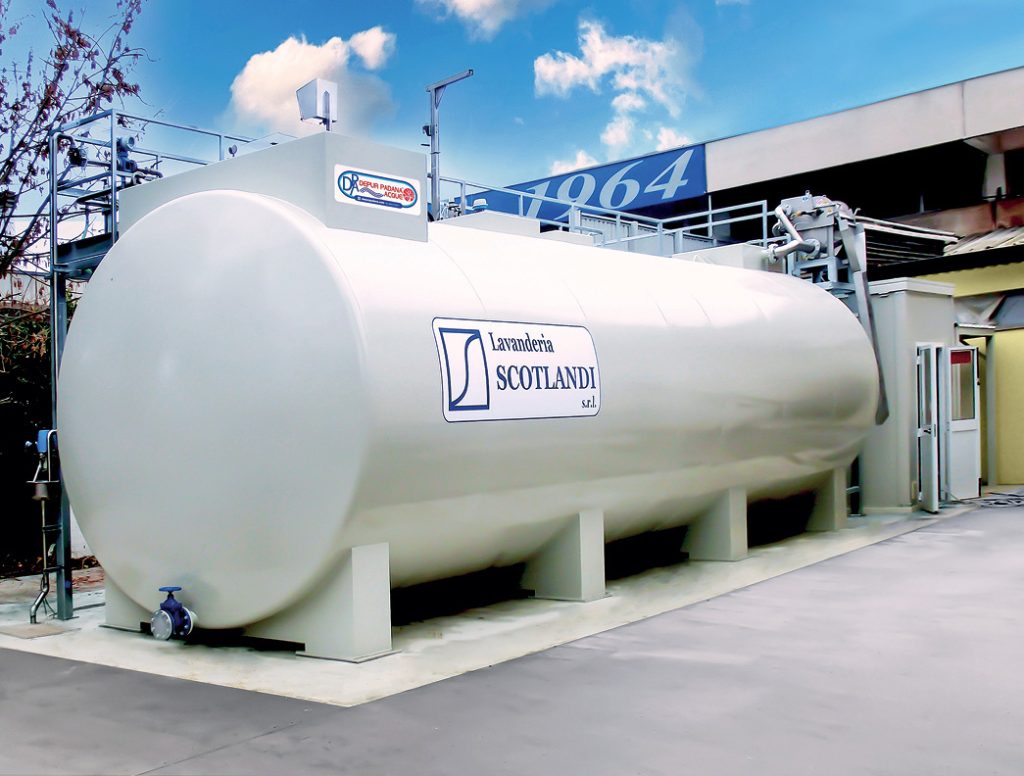
Biological wastewater purification plant, ECOBLOCK® Series, mono-block
structure equipped with MBR technology.
Installation at LAVANDERIA SCOTLANDI – BOLOGNA
But your role does not end just with the supply of the equipment, right?
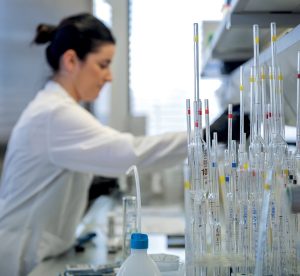
“Exactly. In addition to supplying the equipment, we also ensure the scheduled maintenance. We have in-house technicians and a widely distributed external service network that carries out scheduled maintenance across the entire territory. These are annual contracts that renew over time, and some customers have been with us for over thirty years. As part of the scheduled maintenance, as DEPUR PADANA ACQUE, we carry out analytical control activities through our accredited in-house laboratory, that analyses all samples taken by our technicians at each stage of the process. Analytical activity is crucial, and only the transparency of the water is not enough to guarantee that it is free of impurities”.
Which are the personnel professional skills that you rely on, in your company?
“They are many and diverse skills. For design, we rely on a technical department with dedicated draftsmen, designers, and engineers who are managing the essential phases of the projects. We have chemists in the laboratory who are essential for the analytical phase. The workshop includes welders, painters, assemblers, workers with different specializations. A production process that makes use of a variety of skills. Currently, we outsource the heavy carpentry works and the production of electrical panels. Everything else is done by us.”
Which is the “great frontier”, the technology goal when it comes to wastewater treatments?
“In the specific laundry sector, the goal is to achieve total water reuse. We are in a context of dramatic climate change, and in certain cyclical phases there is also the problem of water scarcity. What is at stake is this. Water and energy, even for laundries, are and will always be crucial issues. The goal is to get to the point of proposing zero-discharge purification plants that allow laundries to reuse water on a “limited cycle”, which will significantly reduce costs. The challenge is this: we are already working on it and we have fitted solutions that allow for significant water recovery. The internal research and development of DEPUR PADANA ACQUE is strongly focused on achieving this goal. In our field, there is something new to learn and discover every day. Our strength comes from curiosity, and the founder of the company embodies the quintessence of this energy. Innovative solutions. This mentality has been spread throughout the company. All of this necessarily leads to gaining a competitive advantage. Technology is important, but it is essential to be combined with a reasonable cost of intervention”.
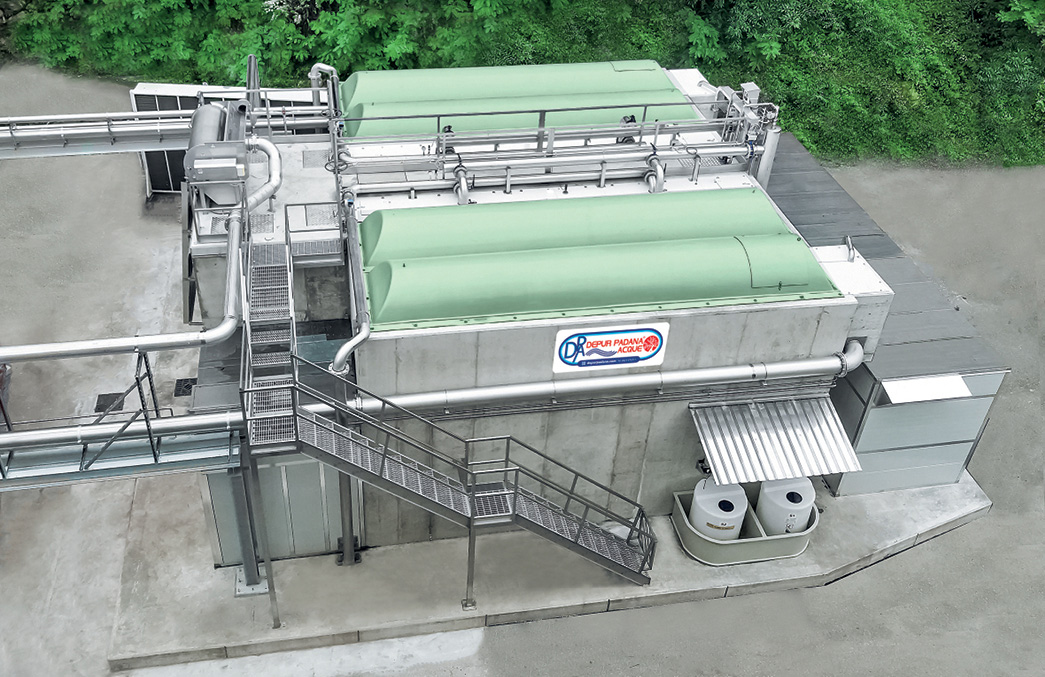
Biological wastewater purification plant with cyclic/sequencing operation (”SBR”),
capacity 60 cu.m./day. Wastewater treatment resulted from washing
and finishing of socks and technical sportswear.
Installation at SM3 d.o.o. – Tešanj (Bosnia and Herzegovina)
 Are there any European, national, or regional regulations that encourage the potential user to employ your technology and contribution regarding the water purification?
“Since 2018, even for the field of wastewater purification, it arrived a big contribution from 4.0 Industry by recovering a large part of the investment as tax credits. In the last five to six years, our production has substantially increased, also due to these incentives. We are currently waiting to see the provisions of 5.0 Industry, which is focused towards energy efficiency and sustainability. We hope that this legislation will also have the same driving effect as the previous one. Already with 4.0 industry we had to implement our plants in line with the specific requirements, in essence we will do the same thing also for 5.0 industry. A new path is underway. When it comes to local incentives, there are often regional concessions but also national regulations that push investment for macro areas such as for the South, always as a tax credit, a measure that means a significant boost to investment.”
Do you think that it has been made some progress in the recent years in terms of environmental awareness?
“In environmental terms, we are fortunate in Italy to have very advanced regulations at the European level. Legislative Decree No. 152 of 2006 regulates, among various environmental issues the wastewater discharge. The provision requires that companies which contaminate water during production processes and then have to return it to the environment must comply with very stringent parameters. However, I must say that today environmental awareness and sensitivity has objectively increased.
The willingness to invest, the driving force for business development, the support of various incentives and benefits, environmental awareness – the combination of all these factors that has represented, and represents for us as DEPUR PADANA ACQUE a real virtuous circle for all these years, and there are all the conditions for projecting it in the future as well,” concludes Giovanni Pio.

DEPUR PADANA ACQUE S.r.l
Viale Maestri del Lavoro, z.i. Borsea
45100 Rovigo RO – Italy
Phone +39 0425 472211
info@depurpadana.it www.depurpadana.com